Return to the Frank Passic
Any photos not otherwise credited are from the personal collection of Frank Passic, Albion Historian.
|
Morning Star, May 15, 2026, pg. 5 Each year at this time we feature one of Albion's Civil War soldiers. First Lieutenant Philip Weitzel (1845-1910) was one of Albion's commissioned officers, but with a different twist. Philip was one of Albion's "Orphan Train" children, and was dropped off here on July 3, 1857 at the age of 12. He was born in Ober Ingethrens Hussens Darmstads, Germany under the name of Philip Waitzer, and came to America at the age of 6 with his parents. His father's name was Earl. Philip resided in New York City, living with his mother at 228 Avenue A between 15th and 16th Streets. While there, Philip had a job stripping tobacco at his young age. With his mother's permission, Philip was brought to the Children's Aid Society by a Mr. Bremer and was placed on the June 30, 1857 "Orphan Train" that stopped here in Albion along with 28 other children. Arriving in Albion, Philip was originally placed with Simeon Barker for a short time, but he eventually settled with the Darius (1822-1896) and Mandana Warner family, Albion Township farmers. Darius was a son of Albion's pioneer and builder Wareham Warner. Philip's name appears in the 1860 U.S. Census living with the Warners under the name of Phillip Wightsel at age 15 as a farm hand. An 1881 published report by the Children's Aid Society also states that Philip "was placed with Mr. Elisha W. of Albion, Mich," which would have been Darius's brother. Often the Orphan Train boys worked on farms and were moved as needed for farm work. Philip joined the Union Army during the Civil War at the age of 18 on September 5, 1863, where he served as a Sergeant in Company A of the 11th Michigan Cavalry. On July 20, 1864, he joined the 116th Regiment, United States Colored Infantry at Camp Nelson, Kentucky as a 2nd Lieutenant in Company H. In those days, white officers were in charge of the colored soldiers. The Regiment was organized in June and July, 1864 and was assigned to various Brigades during its existence. Wikipedia mentions that the 116th Regiment took part in the Sieges of Petersburg and Richmond beginning in October, 1864, and remained there until April, 1865. This included several engagements, such as the north side of the James River, Fatigue duty at Deep Bottom, Dutch Gap and Richmond, Hatcher's Run, Appomattox Campaign, Boydton Road, the Fall of Petersburg, Pursuit of Lee, Appomattox Court House, and the Surrender of Lee and his army. Afterwards, the Regiment was moved to Texas, serving at Ringgold Barracks at Rio Grande City. Finally, the Regiment was moved to New Orleans, Louisiana and was disbanded there in January, 1867. Philip was mustered out on January 17, 1867 and then returned to Albion. Philip's leadership qualities during the War were recognized by not only his superiors, but to those soldiers of which he was placed in charge. The book "History of the 116th Regiment U.S.C. Infantry by Lieut. Col. Charles Kireker" states (pg. 105). "Second Lieutenant Philip Weitzel was the first officer assigned to the Company, after its organization, who was afterwards promoted to First Lieutenant for gallant and meritorious services." Page 106: "On November 22, 1866, the members of Company H presented a fine gold watch and chain to First Lieutenant Philip Weitzel, as a testimonial of their regards to him as an officer and a gentleman." In May, 1865, Philip wrote the Children's Aid Society to report to them how he was doing. In a letter he stated that he was stationed in Washington D.C. and was in charge of brigade ambulances. Years later in 1881, a representative of the Children's Aid Society, Mr. Fray, visited Philip in Albion, and in his report stated, "Philip returned from the War a commissioned officer and had saved almost $1,500. He purchased a farm four miles from town and married a niece of his foster father. Mr. Fry said that Philip was still in Albion and was looked upon as one of the promising and successful young men in the community." Philip was married to Martha Warner (1848-1892), a daughter of William A. Warner, another Warner brother to his foster-father. Philip purchased an 80-acre farm on the north side of Behling Road (F Drive South) just inside Jackson County in Concord Township in Section 18. The couple had four children: Edward (1868-1916), Stanley (18787-1960), R. Arthur (1875-1940), Dana (1883-1977) and Clara (1884-1894). There are still descendants in our area today. Upon his death at home on October 20, 1910, he was buried in Riverside Cemetery in Albion, Old Grounds Block 2, Lot 26 (Findagrave #8126861). Note: His tombstone is now partially covered by a growing tree trunk. Philip was a member of the local E. W. Hollingsworth Post No. 210 of the Grand Army of the Republic. From our Historical Notebook this week we present a special treat. The first photo features a daguerreotype of Lt. Weitzel in his Civil War uniform. The photo is spotted and the image is dark. The second photo is the same image, but it has been cleaned up, repaired and colorized utilizing AI (Albion Intelligence) courtesy of Abu Malak Fad of Alexandria, Egypt who volunteered to do the restoration after I posted it on a Facebook photo restoration site. How many of our readers had ancestors that served in the Civil War?  Daugerotype Portrait of Philip Weitzel in Uniform
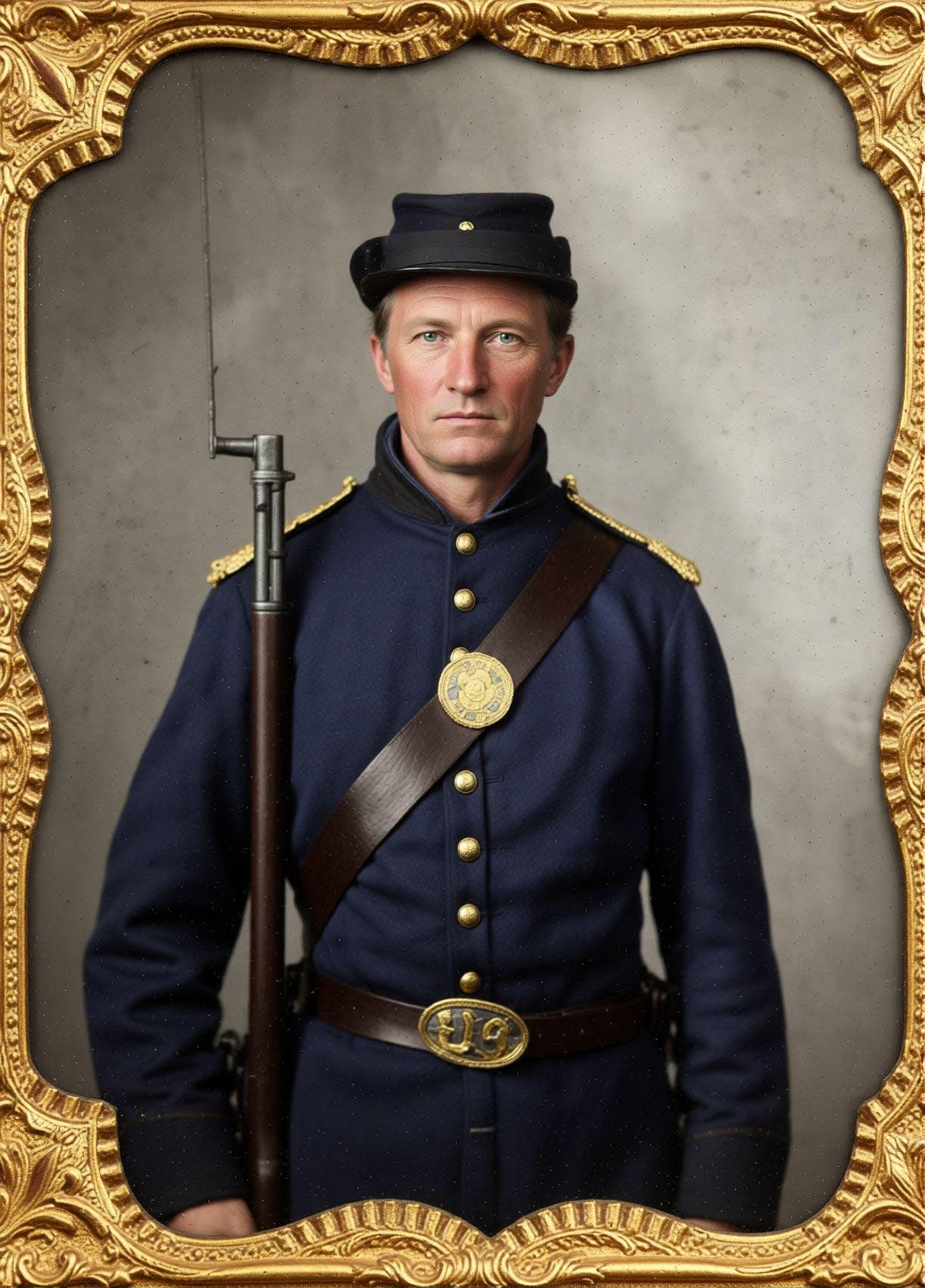 Repaired Image
All text copyright, 2026 © all rights reserved Frank Passic | Artwork copyright Maggie LaNoue © 2026
| |