Return to the Frank Passic
Any photos not otherwise credited are from the personal collection of Frank Passic, Albion Historian.
|
Morning Star, August 7, 2026, pg. 5 Recently it was announced that the Greater Albion Chamber of Commerce, the Albion Community Foundation, and the Albion Economic Development Corporation have all moved into the same building at 101 N. Superior St. Historically, this is the Parker-Kessler Block, now known as the Ludington Center and still owned by Albion College. This site was once the location of the Gale Manufacturing Company, a major 19th century agricultural implement firm here in town. After it moved to a new location on N. Albion St., the fledgling new Albion Malleable Iron Company located here. Its property included where City Hall is today. When the Malleable also moved to N. Albion Street, in the late 1890s, the Superior St. factory was demolished. In its place a new mercantile and office building was constructed in 1900, called the Parker-Kessler block. Warren Scott Kessler (1845-1933) was the founder of the Albion Malleable Iron Company. His step-son was Harry B. Parker (1889-1936), who served as the Malleable vice-president and general manager for many years. If the name Parker sounds familiar, it should. The Parker Lab building on the northeast corner of N. Albion and W. Chestnut streets served as one of the Malleable's operational buildings, and is still standing today, albeit a bit abandoned. The Parker Inn Hotel was constructed in 1926 to replace the Hotel Albion, and served Albion's hotel needs for many years. Mr. Parker also donated the land for the site of City Hall on W. Cass St. which was once part of the Malleable property. The Parker-Kessler block has served various needs during its existence. It was the location of Albion's Post Office before our present one was erected. Numerous stores have been located here, such as Hawes' Drug Store on the corner, and Wingard's Bowling Alley on the 2nd floor. Masonic Lodge rooms were once upstairs. Who could forget the many years furniture stores were located here such as Bishop's Furniture, Howard Reed Furniture, and Knuth Furniture? Albion Floor Covering was also located here. With that stated, we wish our community organizations now located here success in their endeavors. As the president and CEO of the Greater Albion Chamber of Commerce Billy Beers has recently stated, in the Chamber newsletter, "We now become a one-stop-shop for all needs within funders, entrepreneurs, start-up businesses, existing businesses, Chamber members, residents and visitors alike. We are now together; we are not working to serve everyone together for the communities that we serve." A hundred years ago during the 1920s the main floor was the home of the Fidelity Store, a variety store that carried clothing, dry goods, and groceries, The Vaughn & Ragsdale clothing store and is listed in this location in the 1930 City Directory. The 1934 Directory however, lists the site as vacant. On December 4, 1934, Bishop Furniture moved into the building and it was occupied from then on. From our Historical Notebook this week we present an historical photograph of the Parker-Kessler Block taken during the early 1930s when the main storefront was vacant. Notice the angle pattern by which the bricks were laid, and the angle parking which once existed in downtown Albion until after the new bricks were laid in 1940. The main window proclaims "Better Housing Show, Albion," evidence of a temporary situation. On the far right we see a store with an awning. This is the Great Atlantic & Pacific Tea Company (A & P) grocery, one of their two locations in downtown Albion at the time. How many of our readers have visited this building since the new trio of community organizations have recently moved in? Give them a friendly visit and see for yourself what is now available there. 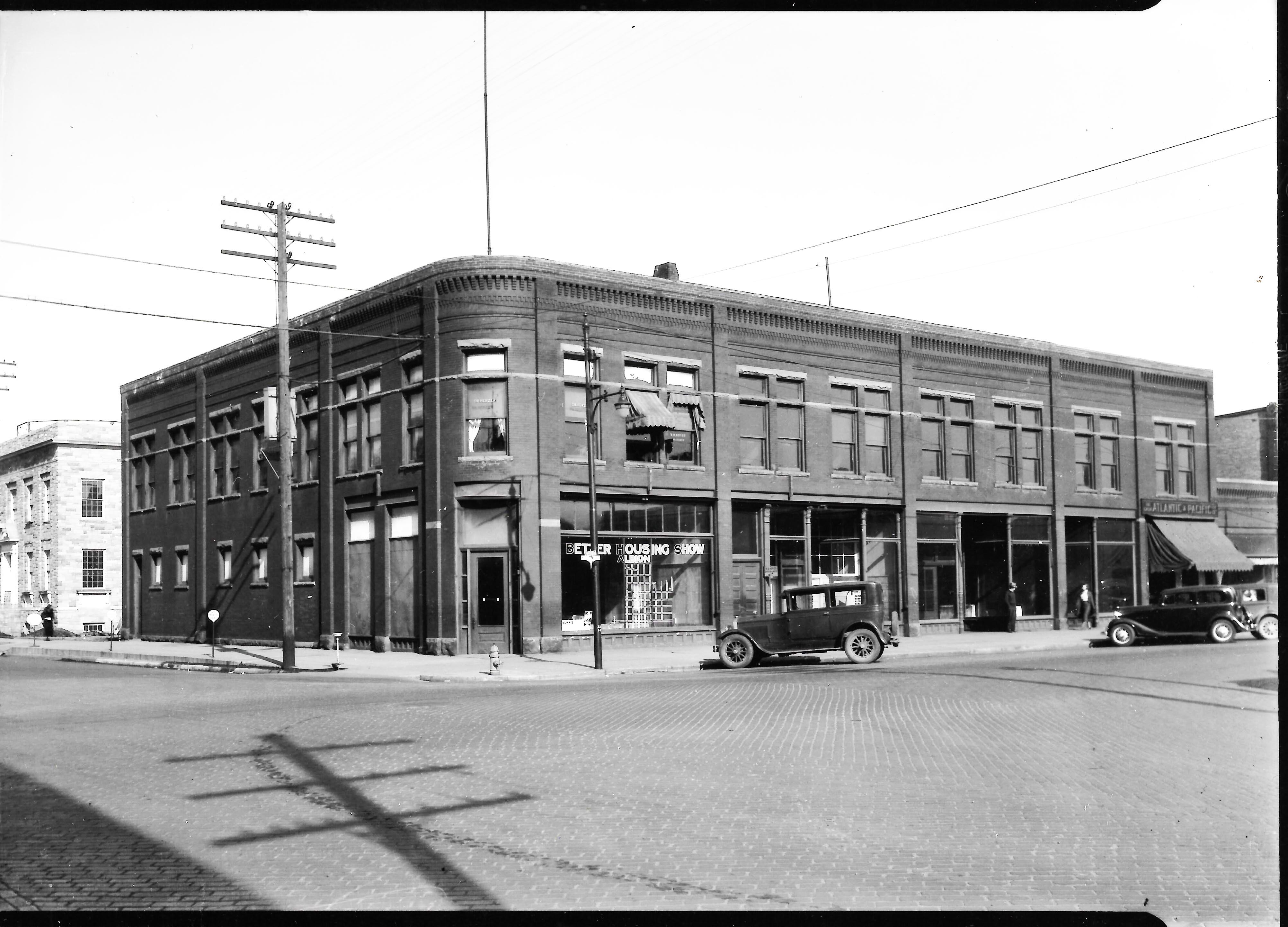 The Parker-Kessler Block during the early 1930s
All text copyright, 2026 © all rights reserved Frank Passic | Artwork copyright Maggie LaNoue © 2026
| |